
A safe team, the thinking goes, is one where everybody feels comfortable.
By that measure, hers was flawless. Nobody was shouted at. Nobody was handed hard feedback. Euphemisms were favoured over candour, and asking the uncomfortable questions - pointing at the gap between what people said and what they did - felt aggressive and was avoided.
Then a failure landed on her desk that half the room had seen coming for weeks. She asked why no one had spoken up. Her COO said, carefully, that there had never seemed a reason to.
He did not say he was afraid to speak. There was simply no reason to - nothing was being asked of anyone that made speaking about the problem worth the trouble.
Psychological safety is two things. Safety on one axis, standards on the other. High warmth with low standards is its own square, and it has a name.
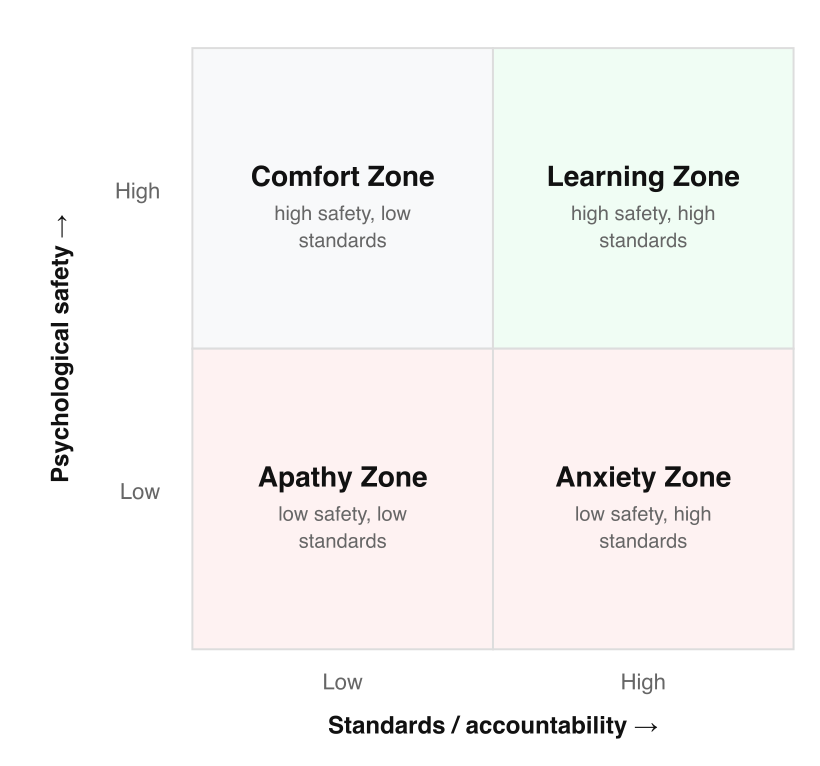
The comfort zone is where people leave every meeting feeling fine, and the failure everyone saw coming arrives before anyone speaks about it.
Standards are never tested in good weather. Nobody needs to say the hard thing when the numbers hold. Then the numbers stop holding, and the warmth proves hollow. What replaces it is normally panic. And the lack of candour makes the fix take twice as long while everyone circles the truth.
There is more than one way to arrive at comfort. One is to avoid the uncomfortable conversations. The other is to have them so regularly that high standards become ordinary and speaking up needs no occasion.
The second kind of comfort will survive the hard times. The first is the quiet before the failure many saw coming.
When your team leaves every meeting feeling fine, ask yourself which comfort it is.
See also: Psychological Safety (Leader Slides) — from the Whole Earth catalog